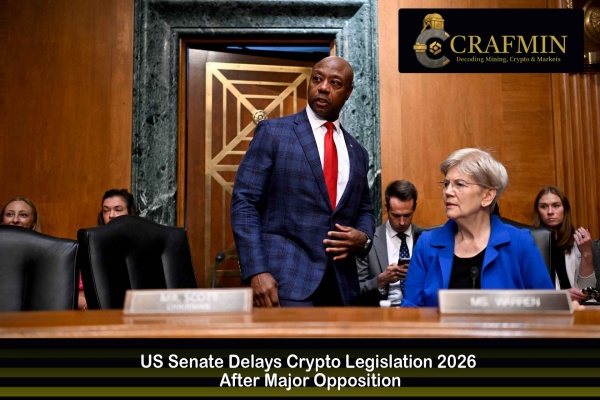
After the opposition of the CEO of Coinbase, the US Senate Banking Committee decided to postpone a key discussion on a draft regulatory law for digital assets and thereby rethinking the terms of the framework by the legislators.The delay thus brings the global eye on Crypto legislation 2026 and also raises the question of whether the Senate can strike the right balance between protecting investors and fostering innovation. Initially, the lawmakers were ready to hold a debate on the issue of the classification of crypto tokens as either securities or commodities.They were also prepared to transfer the supervision of some market sectors to the Commodity Futures Trading Commission. In its present form, Coinbase opposes the U.S. crypto bill, claiming that it would not only damage the wider ecosystem but also restrict consumer benefits.The draft bill was designed to set out the conditions under which tokens are considered securities, commodities or other asset types, a very important step in the clarification of US digital asset laws.It also planned to enlarge the CFTC’s regulatory jurisdiction over spot crypto markets, an agency traditionally concerned with futures and derivatives markets.The proposal had certain restrictions on interest-bearing positions on stablecoins and how the rewards on stablecoins would be taxed. Critics say that these provisions might unintentionally restrict the legitimate product offerings in the sector.Armstrong remarked that Coinbase couldn’t back the legislation as is, and he indicated to stakeholders that it was riddled with “too many problems”, which could negatively impact the innovation and competition.He pointed out what he termed a de facto prohibition on tokenised equities, a downgrading of the CFTC’s jurisdiction, and provisions that might “wipe out rewards on stablecoins.” Coinbase’s position has been a major factor in negotiations as it has poured millions into lobbying and political action committees supporting pro-crypto candidates and policies. The company is still hopeful, as it has made it clear that it would rather have no bill than a bad one, and that interaction could produce better results.Due to the delay, senators might now tweak the draft and look at a broader set of amendments to solve the industry’s problems. The delay might push back the timeline for adopting an all-inclusive legislative framework, thus leaving the crypto market under the same regulatory uncertainty for an extended period.Many in the industry think that a very strict rule gap would put American exchanges at a disadvantage versus their foreign rivals. The controversy displays a contention that is wider in scope and is about finding the right balance between innovation on one side and investor protection and market integrity on the other.Senate Banking Committee Chairman Tim Scott referred to the delaying action as an indication of the distributed conversations among a wide variety of stakeholders from both sides of the aisle. He pointed out that the top people in the crypto world, the financial industry, and the government are all together in the right way.



 Texas Luxury Home Remodeling
 Toyishland: Exciting Kids' Motorcycles for Thrilling Adventures
 Gas Boiler Installation Local/South East UK
 Me, Myself D1T